






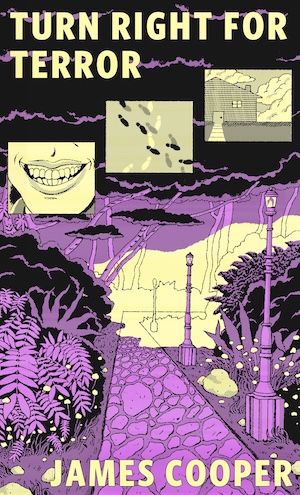
An elderly woman reminisces about her strange and frightening experiences as an actor in a supernatural television show that ran in the 60s.
Novelette | 13,500 words
I first caught sight of Rose Ward in the dining room of the care home. She was raising a loaded fork—slowly, like it was a chore rather than an indulgence—to her puckered mouth and wearily accepting whatever mush it contained. Muzak played in the background, the melody lacking definition, much like the residents occupying the room. Life here—such as it was—rumbled on at half speed, the last few months—years, if these poor devils were lucky—condensed into random naps, routine pill-popping, and long periods of aimlessly killing time. The men and women emptying their contingency funds to live in the Greenwood Meadows Care Home had been reduced to hollowed-out husks, inconspicuously crawling towards the end of their days. Their greatest achievements, the landmark events shaping their life’s journey, had already happened in the past.
That was certainly true of Rose Ward. She had played the role of Bird Dog in the 1960s TV show Turn Right for Terror. If I recalled correctly, her character was a strange, unfathomable figure who appeared every week as part of the show’s recurring motif. It was an odd little programme, designed to pick up some of the viewers who had been drawn to shows like The Prisoner, Armchair Theatre, and the ITV Play of the Week, which often featured speculative stories.
Turn Right for Terror had always been one of my particular favourites. The concept was brilliant, but a little nuts. Each week, the show started with new characters driving down a nameless road and taking an ominous right turn when they got lost. The conceit of the show was that, though the right turn was the same every time, it always led somewhere different, the destination being the weirdest place the writers could create on the limited budget they were assigned. The only recurring character was Rose Ward as Bird Dog. She played some kind of sentinel, or lookout. If memory served, the most notable thing about her character was that in the three series it aired, Bird Dog only ever had one line of dialogue, and it had arrived right at the end of the final show: “A truth will not cease to be true if you silence the speaker.” For a while it had become a kind of cultural watchword and appeared on T-shirts, postcards, and urban art. The fact that the line seemed to encapsulate the social anxieties at the end of a decade of political and civil unrest clearly served to boost its popularity.
I looked across the dining room to try and confirm my sighting of Rose Ward. She had always been very distinctive—that was no doubt why she’d been cast in the first place—and over the years very little had changed. She was still tall, though life had dragged her down somewhat and she was now more stooped than I remember—due to a weakening of the shoulders, perhaps—which was evident even in the chair. It was Rose’s face, though, that had truly distinguished her. The kind of face my father would have called a mud-fence mush, designed to repel rather than attract. It was long like an old boot and bore the look of a traveller who had journeyed far and seen much—a peculiar impression, I know, but one I was convinced had been to her advantage when playing Bird Dog in Turn Right for Terror. Wedded to this enigmatic expression was the dark wine-stain that discoloured her skin and ran from the edge of her left eye all the way down to her chin. It was still there, of course—creased and perhaps not quite as sinister as it had looked on my parents’ rented Rediffusion TV—and very much remained her defining characteristic, covering her cheek like a bruise.
No doubt about it, I thought. That was Bird Dog, sitting across from me and methodically eating her lunch; the curious creature I had watched on TV when I was a teenager, policing the entrance to the unfamiliar world beyond that inauspicious right turn…
I kept my eye on her for the next ten minutes as she finished her meal. Eventually, she rose from the table and used her mobility aid to cross to the bay window, where she settled into an armchair overlooking the rainy meadows surrounding the Home.
I glanced at my own mother, still blissfully cradled in the arms of yet another nap, and decided to see if Rose Ward wanted any company. I wandered over to the bay window and pointed at the empty armchair opposite the one in which Rose was comfortably seated.
“Mind if I join you?” I said.
Rose turned that mud-fence mush of hers in my direction, and I was tempted to recoil. That I didn’t was testament to my desire to speak with her about her role as Bird Dog. Seeing her again in the care home had triggered a rush of nostalgic longing—both for the show itself and for the past, in which I had been younger, bolder, and eager to make an impression of my own in the entertainment industry.
“Don’t see no queue,” Rose said dismissively. She turned her head away from me and gazed at the rain chasing itself down the window.
“I’m Ellen. That’s my mum over there, Nelly, the one dozing by the coffee machine.”
If she was even remotely interested, she was disguising it extremely well. Old age had endowed these women—and they were mostly women in here; men were uncommon, probably because very few of them were able to drag their way to their nineties and beyond—with a kind of unassailable indifference to others and what they might be feeling. These old crows could say whatever the hell they pleased and get away with it; it was one of the few blessings of having an unexpectedly long shelf life.
“I used to watch the show,” I said, refusing to give up. “Turn Right for Terror.” A flicker of interest, perhaps, from Rose Ward. “It got me through some difficult years when I was a kid.”
“You a journalist?” Rose asked. There was something bitter about the way she said it, a simmering resentment.
I shook my head. “I’m just here visiting my mother. She’s over there, see? The one recharging her batteries.”
Rose was unconvinced. She frowned, trying to get the measure of me. “Did that shit Walter Nearing send you? I never did trust him. None of us did. He was always a little prick, and you can tell him that from me!”
The random thread of her dialogue caught me by surprise, as did the violence of the language. Rose Ward might have been old—ninety-three, as it turned out—but she hadn’t lost any of her faculties. And she clearly had a gutter mouth to rival a sea dog.
She was still weighing me up when she added: “That business is all behind me. It’s ancient history. I have nothing more to say on the matter.”
She’d just given me a lot to unpack, and I sat in the armchair trying to get my mind around whatever Rose was alluding to. I cast my mind back, trying to retrace the narrative this old woman was presenting to me—albeit in ragged scraps of memory—but the sixties could barely be glimpsed in my tarnished rearview mirror; that particular decade was a long way behind both of us.
Unable to tap into Rose’s train of thought, I opted for the safe route and offered a neutral response instead.
“I don’t know anything about that, Rose. I just wanted to come by and say hello. Tell you what a great show it was.”
I rose from the armchair and made to return to my mother, though she was still lost in the land of Nod.
“What’s the rush, missy? You got a train to catch?”
Rose was studying me carefully, and I realised my polite retreat had worked some kind of reverse psychology on her, though this hadn’t been my intention. I appeared to have bought myself more time in her company. I sat down again in the armchair and offered Rose a friendly smile. The baleful glare she cast my way suggested that this simple gesture wasn’t at all welcome and might in itself be enough to get me banished from the room.
“You’re very lucky,” I said. “This is a beautiful place.”
I glanced around at the soothing environment that the residents’ life savings had bought them: bespoke, upholstered armchairs, luxurious sofas with pressure-relieving cushions, all amounting to a carefully crafted living space full of furniture and plants that wouldn’t look at all out of place in a high-spec London hotel. I was only a dozen years or so from probably needing something like this myself, though I doubted I’d be able to afford a place as elegant as Greenwood Meadows. My mother was only present on a wing and a prayer, having cashed in all her assets and sold the property she and my father had lived in their entire married life. The beauty of the British care system: designed solely to screw over the poor.
Rose had mustered another sour look and pitched it in my direction. “If you’re going to sit there and make shitty small talk, I suggest you leave, dearie. I don’t do the beauty parlour thing very well. It’s a waste of breath and I have little enough to spare as it is.”
Fair enough, I thought. Rose was candid, if nothing else. At least I knew where I stood. A little rude, perhaps, but that’s what lived experience in the trenches bought you: a frank, no-nonsense approach where every spoken word was shot straight from the hip.
I decided to try the same blunt strategy. “I expected someone different. You’re nothing like Bird Dog in the show. She was so cool and unassuming.”
Rose snorted. “Bird Dog was a fucking clod! I wasted three years of my life on that show. All I had by the end of it was a nervous disorder and an unshakeable itch to take my own life.”
I must have looked shocked. I was no stranger to bad language—my Harold used to turn the air blue when he was in a mood—but hearing it from the mouth of this old lady in an environment as calm and comforting as this was like hearing it muttered by a confessor in a church. Not only that, Rose had packed an awful lot of history into those simple sentences. My brain was spinning with intrigue. Rose Ward’s time on Turn Right for Terror had clearly been nothing short of a personal disaster.
“My God,” I said. “Even after all these years you sound so upset. What the devil happened?”
She turned her head in my direction, that desperately ugly face as unflinching as ever. There was a good twenty seconds or more of assessment as she seemed to consider whether or not to speak further on the subject. Then she said, “That show nearly killed me, that’s what happened. It stole a piece of my life and filled the space with the weirdest fucking things I ever saw in all my ninety-three years on this planet. Sometimes, dearie, the world tosses you a bone and you think you’re the luckiest son of a bitch in the universe. Then that bone gets stuck in your throat, and suddenly you’re struggling to breathe. That’s what that show was like. A lucky break turned bad.”
“But you played Bird Dog for three years. Couldn’t you have walked away?”
She looked through the rainy window into the distance, perhaps seeing her younger self, entangled in the nuances of the show.
“That’s the shiftiness of contracts, Ellen. Easy to sign up, not so easy to break free.”
“Didn’t you have an agent who could help?”
“Oh sure. But they weren’t like they are now, compelled by an industry-driven Code of Good Practice. Mine was a guy named Marcus McPhail. I should have known what he was going to be like from his Christing name!”
“That bad?” I said.
Rose’s face darkened; the wine stain turned the colour of rotten fruit. If the agent had been present in the room right then, I had no doubt that, even in her declining years, Rose Ward would have happily taken a meat cleaver to his skull.
“Marcus was a spineless shit, easily intimidated by the studio. As long as his monthly cheque rolled in, he was happy. I might as well have been represented by a dumb kid.”
She fell silent, her breathing becoming a little too fast and ragged to be fit for purpose. I gave her a moment to calm herself down. My eyes wandered around the open lounge area of the home. I saw a bearded man and a haughty-looking woman visiting a relative who had a blanket over her legs. They were sitting in silence, staring into space, likely as not wishing they were doing something else.
My own mind drifted and I gave some consideration to whether Beard and Haughty still had relations. The body language suggested not. I always wondered if bearded men understood just how unappealing it was for their partner when it came to cuddling. Whenever I saw a man with facial hair, I thought it a clear signal that the individual had pretty much given up on love. Harold had grown whiskers once and it was like being attacked by a shaggy dog! It was bad enough kissing him, but having him scratching around down there? I was sore for days! I told him there would be no more funny business until he lost the beard; unsurprisingly, by the time I’d prepared dinner, it was off…
“You still with us, dearie?” Rose asked. She was scowling at me, though I had come to realise this did not always mean she was annoyed; the grim expression was just the regrettable set of her face.
“Oh, yes. Just thinking back…”
This place was naturally disposed towards people digging around in their own past. What else was there to do here, I thought, but reflect on one’s own experiences, to delve deeply into your personal history to try and locate the grace moments that transported you to a more empowering time?
I think I was blushing, the memory of Harold and me getting up to no good when we were young stirring emotions I’d assumed long forgotten. That my mind had meandered in this direction as Rose was confessing to her own suffering seemed obscene. It wasn’t like me at all. I refocussed and allowed myself to be drawn back to the long shadow of Rose Ward’s unfortunate face.
“You were telling me about the show,” I said. “About what it did to you all those years ago…”
“Not just to me. To all of us. Did you know several of the actors died during the filming of Turn Right?”
I shook my head.
“No, they kept it pretty quiet. I remember Walter calling the staff onto the soundstage at Bray and threatening to wrap up the whole shitshow if news of the disappearances was leaked to the press. That’s what he was like. A tyrant who knew everyone in the business. We were all terrified of being blacklisted and never working again.”
“Maybe your colleagues just got tired of being treated like dirt and left the show without telling anyone. Just up and disappeared. Is that a possibility?”
Her expression clouded over, and I caught a glimpse of the formidable woman she must have been in her pomp. It was hard to imagine anyone—even Rose’s alleged nemesis Walter Nearing—riding roughshod over her.
“If you think I’m making stuff up, dearie, maybe you should just fuck off.”
The words were softly spoken, but the savagery underpinning them was clear. My heart—no longer as robust as it once was—began pumping at an inadvisable rate. I held up a conciliatory hand.
“I think nothing of the sort,” I said. “It was merely a passing thought.”
“Those people disappeared into the illusion we were shooting, Ellen. They turned right and went fucking AWOL. That’s what I’m trying to tell you. There was something very real about that hateful little show.”
I looked out through the bay window, the rain falling hard, making the landscape look heavier. The atmosphere in the room felt the same way: dense, oppressive, heavily charged, as though the past was exerting its own pressure.
“Tell me all about it,” I said, making myself comfortable in the armchair.
And Rose Ward, drifting back through time with her shifting memories, did exactly that, every word ringing clear and true…
Walter Nearing was a real fucking louse, that much you already know. Not much more needed in that department. You’ll just have to take my word for it, Ellen. The picture will become sharper of its own accord. All you have to do is make sure you’re hanging on every rotten word I spit out—do that and the whole shebang will become crystal clear!
In this one episode which springs to mind—I can’t remember the title, things like that slip away from me, dearie—the script called for this family to turn right and wander into some Boschian version of hell. Matt Brank was the writer, a young kid who’d worked with Harlan Ellison in the States and thought he was the new Bradbury, poor deluded bastard. Matt’s writing was always kind of apocalyptic, which drove Walter crazy. The set design for his episodes would take huge chunks out of the budget, and I remember Walter demanding he tone it down. Matt refused and Walter did what he always did in those situations, gave the kid a week’s notice and sent him packing. Last I heard he was pulling pints at The Crown in Dorney on the north bank of the Thames, no doubt dreaming of the best way to drive an ice pick into Walter Nearing’s insipid little brain.
Anyway, Walter had managed to persuade a chap called Tony Gatlin—some big noise from Hollywood, though he was clearly staring full bore into the bottom of the barrel if he was working with us—to appear in the show as the father and husband of this family heading to hell.
Long story short, it became apparent very quickly how Walter had managed to recruit this hotshot from the States. Fucking idiot was a drunk, wasn’t he? This one day we were supposed to be doing a scene where I’m pointing ominously at him across a river flowing with blood. The useless shit spent the whole session corpsing, laughing like he was already running on a full tank, stumbling his way through lines, and writing off the entire morning’s work. The whole rehearsal was interminable. Like performing with a bloody monkey. I remember thinking I’d like to take a right turn of my own into some nightmare world and take Walter the Putz with me. Why he’d hired a loser like Gatlin was beyond me. The damn fool couldn’t act to save his life! Any more cue cards on set and we’d have been a bloody fire hazard. Worse still, this sad old lush was probably getting paid five times the amount I was, which just rubbed salt into the wound. He was a perfect example of the fine art of how to bullshit your way to the top. If I hadn’t been trying to do the same thing, Ellen, I’d no doubt have been mad as hell.
Having a drunk on set was bad enough, but an American drunk? Trust me, you think Yanks are brash and self-indulgent when they’re sober? Try being around one that’s been hitting the bottle hard. On set for ten hours a day, by Christ! That, Ellen, is what the young ’uns of my generation used to call a freak-out! One of those nightmare situations that put everyone on edge and left ’em there till the world itself took a right turn, veering toward whatever calamity lay in wait over the horizon.
I was the last person to see him alive. Ain’t that a kick in the head? We were filming, doing this corny scene where I directed Gatlin’s character to pass through this wall of mist. A fella named Peter Crabtree was in charge of the fog machine, and he’d set the damn thing to its highest setting so it pumped out enough vapour to satisfy Walter, who always seemed to be lingering somewhere nearby during the shoot. There was fog everywhere! I could barely see the other side of the studio. Gatlin looked uneasy even before he entered the fog, though that could simply have been because by then he was already seeing two of everything. I watched him disappear into the mist, and that was pretty much it. Poor bugger never made it out the other side.
There were lots of theories about what had happened, ranging from the rational to the absurd. I remember Walter suggesting he used the cover of the fog to just walk away from the production. It was no secret that Gatlin and Walter had locked horns any number of times over the drinking. Perhaps Walter’s gut instinct was correct, Gatlin had snapped and taken his opportunity to abandon ship. No one could really blame him. I’d personally heard Walter calling him “a roaring drunk who was pissing his talent down the drain!” Hard to take that level of abuse for any length of time, Ellen. I should know. Walter had spat out his fair share of nastiness in my direction during our time together. He once called me a walking skeleton with a face like his arse after a night on the trots. Even after all these years I remember that one. The past can be a real bitch. The bad stuff sticks like you wouldn’t believe…
Of course, it wasn’t long before rumours that the entire production was cursed started floating around. Gatlin hadn’t just wandered off, as Walter and his legal team wanted us to believe. He had been lost in the fog. Got turned around somehow and wandered off the track, only to drop out of sight into God-knows-where. That kind of thing was nothing new to the show, you understand, we’d probably done two or three episodes where similar stuff happened. But in real life to an actor during the shoot? The very idea of it was as silly as most of the episodes we filmed! Turn Right for Terror was nothing more than a goofy drama that brightened the lives of the shiftless weirdos who watched it. No curse. No hoodoo. No old-school kiss of death!
Or so we thought at the time. Over the years, I’ve had plenty of empty hours to think about that dumb show, Ellen, and maybe the Buddha was on to something with his “existence is suffering” schtick. Life is one long motorway of pain, misery, and bullshit. Ever notice that? When the good bits come, they only seem to last for a split second. But the really tough parts? They stick around, haunting you. They’re the moments of your crappy life that you’ll remember when you’re sitting in a care home looking out at the rain. No one ever prepares you for that, do they? They’re the subtle tricks memory plays on you when you’re not looking…
So, Gatlin’s gone, and that particular episode gets dropped. Turn Right’s version of hell has claimed its victim and Walter decides he’s had enough. We’re instructed to say nothing about what happened. Walter tells us there’s a confidentiality clause in our contract, but I don’t believe him for a second. When I check, I discover his threat is nothing but flannel. There’s no such clause, nothing like it. My contract looks like it was written for a different show entirely. There’s lots of stuff in it about working with animals, for Christ’s sake! We had a dog once in an episode, and I vaguely remember a scene involving a few birds, but that’s about it.
When I challenge Walter about his phony clause, he corners me in the ladies’ room and tells me I’m the easiest member of the cast to replace. “I could ship your bony arse out and replace you with a bloody scarecrow and no bugger would know the difference!” he tells me. “You should remember that, Rose. You’re a dispensable beanpole who gets paid to point! You proud of that? Mummy and Daddy tickled pink that their talentless daughter is on the tube? You’re a born loser, a fucking dead duck! Any more back talk from you and I swear to God I’ll not think twice about kicking you out on the street.”
I had to take crap like this from Walter every day of the week. Pretty soon, the way he treated me filtered down to the directors, too. Fortunately, Walter clashed with all of them, so there was a steady conveyor belt of new faces drifting through the show. But they all seemed to pick up on Walter’s hostility toward me and instinctively followed his lead. I was the dog they all whipped, the punch bag they all took a swing at.
Then, only a month or so after Gatlin disappeared in the fog, we were filming an episode about turning right into a world in which everyone was forced by the autocratic leader to constantly smile. Walter had hired a young man named Stephen Meyer—genuinely talented, as I recall, so fuck knows how Walter had spotted him; dumb luck, probably—and he was cast as our par-for-the-course stranger in a strange land.
Except it didn’t quite turn out that way, because Stephen hanged himself during the shoot. Jumped from the steel beams high above the stage—and just checked out. We heard his neck crack from the stage set below. We saw his face turn bloated and red. We all froze and watched him swinging up there like a damn pendulum in a clock. Eventually, some of the crew found a ladder and a small saw. It took three people to climb up there and cut him down.
Rose paused in her story and reached for the glass of water she had brought with her from the dining table. She emptied it and summoned one of the carers to ask for a refill. I watched as she drank this, too, taking small, birdlike sips, rehydrating after her troubling journey into the past.
“God, it all sounds like something from an afternoon soap. A pretty dark one, too.”
“Weren’t no soap, Ellen. This was…I don’t know, some kind of warp in the system. Working on that show was like diving off a cliff every day, never knowing if you’d hit the rocks or make contact with the sea. You ever come across the concept of anomalism?”
I frowned and shook my head, though the word sounded familiar.
“It’s where everything around you feels like an anomaly, like every ticking second that goes by is a departure from what’s normal or expected. That’s what playing Bird Dog for three years felt like. It fucked with the brain, Ellen! Likely as not, it still does.”
“Not everything in this world is meant to be explained,” I suggested, not really knowing what to say. “Isn’t there a bit in the Bible where one of the disciples says, ‘We have seen strange things today’?”
Rose’s distorted-looking face crumpled and she rolled her eyes. “Holy fuck, a sky pilot!” she said. “You go to church, Ellen? Because I really am too old to be converted. They tried it in here when I first arrived. I told those motherfuckers to go to hell in a houseboat! Never bothered me again.” She smiled. “Weird little people, the Christians.”
“I’m not a churchgoer, Rose.”
And even if I was, I thought, I’d never try to convert someone like you. Some people are just godless to the core and no amount of talking can change that!
“I do like to think of myself as a spiritual person, though. I believe in the deep relationships that bind people together, the connection between souls and minds.”
Rose looked to the heavens and whistled. “What rope have you been smoking?” she said, chuckling, the noise reminding me of a clogged drain.
“Tell me what you believe in, then.”
“Isn’t that what I’ve been trying to do?” she said, angrily. “You need to listen closely, Ellen! I told you that at the start. What I’ve been giving you is full disclosure! Christ knows why, but it feels like this is the right time. When I’m done, you’ll see that the only thing worth having faith in is not a higher power, but what you see every day with your own goddamn eyes!”
She was growing agitated, the stain on her face seeming to reflect her mood, the blot on her cheek darkening as she became more distressed. I didn’t want to upset her. I wanted to hear more of her story, no matter how colourful it turned out to be. Reaching back into the past might even help exorcise whatever demons were burrowing inside her head. I wasn’t a shrink, for Heaven’s sake, but I did know that talking things out often had a purifying effect.
“I’m sorry, Rose. I’ll be more attentive, I promise. I know how difficult this must be for you.”
Rose slung a disdainful look—not the first, I have to admit—in my direction.
“Everyone has a grim history if you dig deep enough, Ellen. Even you…”
I knew this to be true but had no desire to explore the matter with Rose. She was the one who had chosen to unload, not me. My baggage would remain locked away. I was here for Bird Dog, and I was getting more of her than I could ever have imagined. Why me? I wondered, a question which would arise again later in the afternoon. And why now?
“You know, I can’t help thinking about your relationship with your producer, Walter Nearing. You don’t strike me as the kind of woman who would accept a raw deal from anyone. Why didn’t you stand up to his abuse?”
“Turn Right was an eternity ago, Ellen. I was a younger woman, and times were different. Besides, I needed the job. And I had a contract. Walter was a real monster, and the truth is, back then, for a single woman trying to make a life for herself in London, there weren’t a great many options available.”
Rose gazed out of the bay window, remembering who she used to be. She had briefly let down her guard, and I saw an acute sorrow clearly visible in her watery eyes.
“Terror can mark people in strange ways,” she continued. “And Walter knew how to march people to the fucking rim of it before they broke. I never stood up to him, Ellen, and I never left the show, either. That I didn’t do one or the other haunts me to this very day. If only I could go back and whisper into that foolish girl’s ear how to handle it. If only any of us could go back, I suppose…”
It was a wise observation, and it left me feeling confused. This woman was such an enigma; sharp as a pin one minute, unreliable as the weather the next. Or, at least, I’d chosen to think of her account as a little slippery. What if, in the final calculation, every word Rose Ward uttered was true?
“You know, you don’t have to tell me any of this. You’re delving into stuff that’s very private, personal business you’ve probably not discussed with anyone for years.”
“Decades, dearie,” she said, chuckling again. “And that’s precisely why I’m doing it. Emotionally charged and stressful events cling to us like fucking ivy, winding round every inch of our brain until it can barely breathe. If I leave it any longer, Ellen, this entire part of my life will be gone. Buried beneath the creeping roots of that damn plant.”
It was a powerful image, and the vehemence of Rose’s words made a strong impression. She was a formidable character, a larger-than-life personality. Could I really see anyone—even the dreaded Walter Nearing—trampling on a woman with Rose’s spirit?
She had clearly indicated a strong desire to confess; if she needed a stranger like me to play confessor, I would oblige, if only because I had such fond memories of Bird Dog and that strange, iconic show.
“Tell me about the boy who hanged himself,” I said.
Rose took another economical sip of her water and continued her tale, settling back into her armchair and mining through the deep earth of the past.
Stephen Meyer—the kid who strung himself up, if you recall—was the kind of actor most of us dreamed of working with. Generous, kind, funny. It was like Walter had made a mistake in his recruitment and actually picked someone who knew the demands of the job, rather than some newbie he could manipulate and torment for a few weeks. We all liked Stephen. He was great fun to be around. Brought real positive energy to any room he entered. We’ve all met people like that before, Ellen. There’s still a few left in the world, thank fuck!
Except poor old Stephen had some demons of his own. Being a gay man in ’60s Britain can’t have been easy. It was still illegal, you might recall, and I suspect Stephen lived in constant fear of prosecution, blackmail, and violence. When this juicy bit of gossip got out at Bray, as it was always going to in such a tight little community, there wasn’t really any place to hide. He was shunned by nearly everyone, and Walter—always at his happiest when he located a weakness he could repeatedly pick at—was in his fucking element! “Nancy,” “faggot,” “shirt-lifter,” “poofter”—these were some of the tamest of Walter’s pet names for the poor kid. At his meanest, he also had a few choice expressions involving the anatomy and bodily fluids, but I think we’ll spare ourselves the indignity of resuscitating those today, don’t you?
Suffice to say, Stephen had a tough time around the studio. Back then, people weren’t as vile as they are today, but there was certainly enough malice to go round. And Stephen tended to bear the brunt of it. I’m ashamed to confess that for those few weeks on set I was glad to have him at the shoot, if only because it spared me from Walter’s wrath. It’s not an easy thing for an old trot like me to admit, but it’s true. There was a new sacrificial lamb in town, and I was happy to let him bleed for his sins.
Doesn’t show me in a particularly good light, Ellen, does it? I’m sure you’re thinking I was no better than all the rest. And it was true, to some extent. I didn’t participate in the bullying and the intimidation, but I didn’t stop it, either, which now that I think about it, is no less despicable than Walter calling him a “Soho fuck-magnet.” Probably worse, by Christ!
Anyhow, all that was bad enough, no doubt. But there was more, another burden Stephen had to bear during his time with us, one that none of us really considered at the time, but which surely played a part in his final act.
I think I mentioned that the episode he’d been cast in was about this cock-eyed universe in which a lunatic overlord demands his subjects constantly smile. Hard to imagine playing a character like that, I suppose, but the reality was that every time I saw Stephen, either rehearsing backstage or running through endless fucking takes to satisfy yet another heavy-handed director, the kid was wearing an artificial smile. I don’t just mean smiling when the cameras were rolling, or during a run-through, I mean all the fucking time! Picture for a minute what it must have been like, Ellen. A young man showing up for work every day only to be preyed upon by Walter and his goons every waking minute. And what response is he allowed? An endless, ongoing, unendurable smile…
And in the end, Ellen, that smile he wore got the better of him. Because he couldn’t endure it. No one could. He was the smiling “ponce” who hanged himself on film. And you know the worst part? That smile was passed along. I caught Walter trying to hide it on his fat, shit-eating face. I stood there and watched him do it. Disguising the monster within…
Another break, this time to gaze wistfully across the room, perhaps running through that awful time when Rose had played her own part in the death of a young man who had clearly deserved better.
If she wanted to be forgiven for her behaviour back then, I certainly wasn’t the person to grant it, but I doubt that’s what she was after. If anything, she probably wanted something more philosophical; not a judgement so much as an interrogation of the past; of how such a shameless act could ever have been permitted in the first place.
“It’s a truly appalling story, Rose. It’s hard to know what to say. They were different times back then. Terrible in so many ways.”
“You have no idea,” she said. “Look at you. Still a spring chicken, for fuck’s sake.”
She tried to grin but her face wasn’t ready for it, and it looked ghastly. I allowed myself a wry smile, though, mostly at Rose’s notion that I was still young. I hadn’t been in that particular ballpark for years.
“Almost impossible to work on such a troubled set, I imagine.”
“And yet we did,” Rose said. “Every single day. Walter had this strange idea that conflict in the creative arts only ever produced better results. He insisted that on-set tension generated energy, engagement, and emotional depth.” She chuckled again, clearly remembering the peculiar bubble in which they’d all worked. “Stuff like that might sound good on paper, Ellen, but let me tell you, dearie, the man had no fucking idea what the hell he was talking about! Creative tension was one thing, but malice and abusive behaviour was something else entirely.”
I saw Anish wheeling around the refreshment cart and his arrival interrupted Rose’s flow.
“Tea and cake, ladies? Today it’s chocolate gateau or Victoria sponge. Only the best for my favourite peeps!”
His smile was wide and heartfelt, but I could see Rose’s face twisting into a disapproving glare.
“You said the same thing to Betty and Helen, Anish. I just heard you. We can’t all be your favourites. That wouldn’t make much sense now, would it?”
Anish’s smile fell off a cliff. He looked like a toddler being given a dressing-down for forgetting to do his business in the right place.
“Just trying to be friendly, Rose. Remember that?”
I sat listening to this exchange, thinking that Rose might well have received a lot of abuse when she was a young actress, but she sure as hell knew how to rub someone up the wrong way in her old age. I quickly jumped in, saying, “Just tea for me, Anish. The cake looks delicious, but you know the old saying: a moment on the lips, a lifetime on the hips…”
Anish’s smile returned, though I noticed Rose’s glare had been ramped up, and was now being directed at me. I made a point of not looking at her. The diverting interplay would have driven her nuts, and as for the feeble quip I’d thrown in to try and defuse the tension…well, I could only imagine.
Anish handed me a china cup and politely said, “Rose?”
“Not sure my hips could take any more, Anish. I’d look like a fucking whale.”
And that was that; a pleasant afternoon tea brought to a grinding halt by Rose Ward’s bitter disposition. Anish walked away with the trolley looking like a man who’d narrowly escaped a collision with a ten-tonne truck.
“You could have handled that better,” I said. “You of all people know what it’s like to be treated unfairly.”
Something passed before Rose’s eyes, and for a second I mistook it for shame before I realised she was merely trawling her memory for a forgotten word.
She waved a gnarly hand at me and said, “That thing you do, the playful crosstalk…I can’t do that. I’ve never been able to. Besides, it all sounds so fucking false.”
“You can’t summon a polite word for a nice young man just doing his job? Probably getting paid peanuts, too.”
“Let me guess. You think I’m a monster.”
You’re definitely a dyed-in-the-wool sourpuss, Rose, that much I can say with some confidence…
“We’re too old to change who we are. That applies to both of us. Me, with my silly remarks, and you with…well, yours.”
Rose chuckled, rubbing absently at the ball of her right hand, a telltale sign that she likely suffered from arthritis. I knew the exercise well because I suffered from the exact same joint pain. When it kicked in, the damn thing hurt like hell.
“Where were we before your boyfriend arrived?” Rose said.
I laughed and sipped my tea. “You’d just told me about Stephen Meyer, the poor boy who hanged himself on set.”
Rose’s gaze drifted, focusing beyond the room, seeing only whatever personal narrative lay in the past.
“Right, so we were. And it was after Stephen’s death that things really started to go to shit. We carried on filming through it all, but the show was never the same. Something unspeakable had burrowed under its skin. I could feel it during every scene, a hideous parasite, dedicated to destroying us all…”
I don’t know if you’ve ever been to Bray Studios, Ellen. In the ’60s, it was the home of Hammer Film Productions and became a hub for Gothic horror cinema. As Hammer’s output wound down, though, they began to take on TV dramas and commercials, which is how Walter came to lease part of the studio for Turn Right.
We filmed most of the episodes in this atmospheric Georgian country house called Down Place, which is the main building at Bray. That damn pile used to spook the hell out of me. It was practically derelict, with parts of the floor having collapsed from damp. As I recall, it hadn’t even been cleared properly and still contained old coats and decorative ornaments and the like. It was the perfect setting for a horror film, or any production that operated outside the box. It felt haunted the minute you walked through the door. All those fake murders, all that Kensington Gore…Thinking about it still gives me the shudders today!
Reason I’m telling you this, Ellen, is because I think Bray was always part of the problem. I didn’t see it while I was buried under the weight of its history, but once it was all over and I had time to reflect, I came to realise that Turn Right never really stood a chance. The whole enterprise was doomed from the very beginning…
After Stephen, there was a break. The lawyers and the production team had their work cut out sorting through all the red tape, I suppose. When we came back and started filming again, the atmosphere, the mood of the place, was entirely different. Everyone involved in the show was unsettled. I remember feeling a sense of torment just entering the building, as though there was a procession of demons waiting to greet each one of us as we walked in, possessing us utterly and preying on our vulnerabilities, corrupting the very air we were breathing in.
I know, I hear how it sounds, every ludicrous word of it. But you have to trust me. I can see in your eyes you think I’m overstating how it was back then, but that’s how it felt, I promise you. It was like a darkness settling over the soul. You’re the spiritual one, Ellen. I’m sure you have a better grasp of it than I do. In my head, things get turned around sometimes, but not this, I assure you! Every word I’m telling you is true. That place…that show…it redefined the notion of evil, as far as I understood the term. Before that, the concept had been nothing more than happy horseshit for eggheads to debate on TV. After working on Turn Right, though, I came to a different conclusion entirely. Evil existed. Probably always had. I just hadn’t been paying close enough attention to see it.
The next member of the cast to learn this lesson the hard way was just a kid. I think his name was Daniel, though I forget his last name. How fucking unforgivable is that? He’d been cast to play the son of a family who are taking a trip to see their folks down South, when they make that fateful right turn. I don’t remember all the details. I think it had something to do with driving back in time to the 1930s, our merry band of travellers washing up during the rise of fascism.
The kid, Daniel, only had a line or two, but there was a scene where he was supposed to run down a narrow alley into the arms of a strange man. I know you liked the show, Ellen, but I told you, every episode was screwy as hell. Half the time they didn’t make a lick of sense.
Anyway, Daniel runs down this alley, the whole thing being recorded for posterity, but when he gets to the end—which was just a series of cleverly designed flats—there’s no sign of him. Not a trace. It isn’t until the construction team dismantle the scenery that we find what’s left of the poor bugger: a neatly severed right arm. Cut off at the shoulder as though the blasted thing was nothing more than a prop made of painted wax.
I think Walter came close to having a breakdown after that. I think we all did, actually. But Walter felt it more than most. He was the money man, the chap at the wheel, with the most invested in the show.
By that stage, nearly all of us involved wanted out. It was getting harder and harder to recruit new talent. Who could blame them? Word had started to spread. Turn Right for Terror was a cursed show. Work on it at your peril! It could easily be the end, not just of your career, but of your life! A shitty joke started doing the rounds. Some crap about a trip to Bray really raising the spirits—godawful, if you ask me, but we all heard it, and underneath it was the thing which was really driving people away: fear. Our little production about innocent souls stumbling into an unfamiliar universe had a horrifying echo in the real world. No one wanted anything to do with it, least of all the people working on it every day.
When the next thing struck, it quickly became the last straw. Everything came to a head. Walter had seen and heard enough. And I certainly had, Ellen. Because that last thing didn’t involve one of our guest actors.
The defining moment that led to the show closing its doors actually happened to me…
I didn’t know what to say. There was a long, drawn-out silence as Rose’s statement hung in the air. She was gazing out the window again at the dreary meadow. What she was divulging was a concentration of old grief and suffering, the storage system she was dipping into tainted by a very intimate trauma. I could see the act of disclosure was agonising for her. Why she was putting herself through it, and why she had chosen me as her confidant, still remained unclear.
“I’m surprised it wasn’t shut down sooner,” I said, gently trying to ease Rose back into the present.
“Walter had obligations. The studio was contracted to deliver a completed show, as promised. It involved a complex web of production and distribution agreements. There was stuff in there about adhering to broadcast standards, and managing rights and clearances. I didn’t understand the half of it. There were contractual commitments to all the actors to consider, too.”
I was impressed. It sounded like Rose understood more than she was admitting. For a woman of ninety-three, she certainly seemed to have a pretty solid grasp of how the industry worked. What did I know about showbiz and its inner workings? My own journey in that horribly competitive world had fizzled out before it had even begun.
“Besides,” Rose continued, her extraordinary face churning with distaste, “Walter would never have allowed it. He had too much riding on the show’s success. He only called it a day when he did because of all the pressure applied by the crew and the ITA. In the end, the miserable fucker had no choice.”
Again, Rose’s words—uncharitable and harsh—resonated like a distant echo, demanding further examination. Her relationship with Walter Nearing was a fascinating one. What underpinned the hostility? Why had they never found a way to work together to advance the priorities of the show?
“You and Walter…” I said, treading carefully. “Why such hatred? I get that he was mean to you, probably beyond what was acceptable, even then, but the bad blood between you seems so ingrained. I’m just trying to get the wider context. What happened between you two?”
Rose’s face—stripped of basic muscle reaction due to anatomical quirks—made another valiant effort to smile. It was as unsightly as ever, her mouth drooping, the wine stain stretching taut across her cheek.
“He tried to rape me,” she said softly. “In one of the projection rooms. That might have something to do with it…”
I sat in the armchair, unmoving. Shock had stolen my voice. Eventually, I simply raised my hand to my cheek and whispered, “Oh, Rose…”
“It was a long time ago, Ellen,” she said, still working that ghoulish smile of hers. “The sad sap had asked me out a couple of times and, you know…” She raised her hand and pointed to her face. “I naturally assumed he was making fun of me. Just another opportunity for the bastard to ridicule me and tell lurid stories to his beastly friends of his encounter with the circus freak.”
She paused in her story, thinking back to what must have been one of the most harrowing periods of her young life.
“Of course, it might have been genuine, for all I know. Walter was never easy to predict. He had the strangest taste.” Another grisly smile. “Perhaps he just had a thing for ugly broads…Anyway, I turned him down both times, and our relationship soured fast after that. Then one day, we found ourselves alone in one of the projection rooms, and Walter got a little too familiar. He pushed me against the splicing table and began forcing himself on me. He had his hand up my skirt, the filthy bastard, and I was lucky enough to grab hold of an old film can and clobber him with it—I think the canister was for Hammer’s The Evil of Frankenstein. Ironic, huh?”
She broke off here and began to chuckle, but there was no humour in it, only a profound sadness.
“That was pretty much that. Much ado about nothing, really. Except neither one of us ever forgot it. And Walter became insufferable. He lorded it over me and retained a sense of bitterness about it all that never went away.”
I was shaking my head, wishing there had been some retributive action like in the good old days: a public stoning, a ceremonial scourging, a week in the stocks. She was accusing Walter of attempted rape; the punishment should have been equally extreme.
“I’m so sorry, Rose. I didn’t for a second think—”
She cut me off and said, “Why would you? It’s not something anyone wants to consider, is it? But it happened more often than any of us like to imagine, back in the ’60s. For some men—the really sick fuckers—free love meant exactly that.”
“Did you tell anyone?”
Rose shook her head. “What was the point? Walter was a wealthy man on every board and committee in London worthy of the name. I was just a lowly actress. I looked like someone had thrown a glass of merlot at my face and it had stuck. What voice does someone like that have, Ellen? Not much of one today, I imagine. Back then, you might as well not even exist.”
Rose’s words stung, the bitterness of the revelation like the pulse of some isolated fever. Her eyes were watery and alive, as if gazing at a familiar landmark a long way off.
“Funny you should mention that,” I said. “About the voice. You went three seasons playing Bird Dog and only ever had one line of dialogue. I always wondered about that.”
Rose shrugged and rubbed the ball of her hand.
“That was Walter, too. Bugger refused to let old Bird Dog utter a word. By the third season, my agent—that delicate doily Marcus McPhail—had managed to get a clause written into my contract guaranteeing Bird Dog a speaking role. I never had much faith, though, not in Marcus or the contract. I knew what Walter was like, even if some of the others didn’t. Giving Bird Dog a voice was the same as giving me a voice, of finally recognising who I was. Walter would never do that. He was too much of a pig-headed creep. Better to leave me silent, my face and this ugly wine stain speaking for me. For Walter, that was better than getting his hand up my skirt. I sometimes even caught him smiling in the wings as I was filming, doing nothing more than that inane fucking pointing, and all under the studio’s harshest light.”
“Couldn’t you have had Marcus go after Walter for breach of contract?”
Rose looked flustered and her hands flew up in despair.
“You’re not listening again, Ellen! I had no fucking voice! Neither did Bird Dog. Our lips might just as well have been sewn shut.”
I said nothing, not wanting to further displease her. She was clearly agitated, and I was hardly surprised. She was digging around in the muck of historical events I doubt she’d even reflected on for fifty years or more. Who wouldn’t be unsettled by a mental excavation like that?
“I’m sorry, dearie. I guess all this storytelling is taking more out of me than I expected. I never counted on remembering so much.”
Storytelling? Damn. My heart sank even as I tried to reconcile Rose’s meaning. How easy it was to become entangled in the briars of the English language. Is that what this was, I wondered? Just a story? Or was Rose merely using the word as a colloquialism?
I tried to clear my mind, confused. Rose’s strange narrative was messing with my head, making me overcomplicate my own train of thought; Christ alone knew what it must be doing to Rose.
“I’m sorry,” I said. “I am listening. It’s a fascinating account. Please, go on. You were telling me about trying to give Bird Dog a voice on the show. What happened next?”
Rose looked wistful, her eyes darkening as she caught a glimpse of what followed up ahead.
“The truly horrible bit,” she said. “They made Bird Dog take a right turn in the show…”
I’d been annoying Walter for weeks, reminding him about the clause in the contract, telling him I’d walk out unless the writers removed Bird Dog’s gag and allowed her to speak.
By this stage, Walter could barely look me in the eye, not after all that had happened between us. Thinking about it now, he might even have been ashamed by the way he behaved in the projection room, but it was more likely that he knew I now had some kind of authority over him. He’d tried to rape me, and I’d chosen not to say a word about it, not to the police, not to the crew, not to anyone. Only he and I knew, and somehow—and don’t ask me to explain it, Ellen, because I can’t—but that elective silence empowered me. Much like it did Bird Dog, now that I think about it, so when she finally did speak, right at the end of the whole series, it had this huge cultural impact, and the simple philosophy my character gave voice to seemed to release a collective pressure that had been building for years.
But all that happened much later. As we were making the third season, I was still very much just trying to keep my head above water, sticking close to the director’s notes, listening attentively during the table read before every new episode—which always excluded me, of course, not having anything to say—and basically getting on with the shitty routine of the job.
When it came to filming what would turn out to be the final episode, we all knew it was curtains for the show. Walter was in over his head, the studio was on its knees, and various media watchdogs and authorities were keeping a beady eye on us. Frankly, we were all exhausted and couldn’t wait for the whole bloody nightmare to end.
When I received the script for our last hurrah, I sat down and gave it a quick once-over, barely even looking at it, in truth. Why would I? My role was always pretty much the same. The Grand Sentinel! Turn Right’s regular Prophet of Doom!
Only this time there was something in there that made my blood run cold. A single stage direction I instantly wanted to erase: Bird Dog walks down footpath and turns right…
I kept looking at the line, but it didn’t become any clearer or reveal anything more meaningful beyond what was stated in those eight ordinary words.
I looked more closely at the script for the rest of the show, expecting Bird Dog to have a more pivotal role for once, but that wasn’t the case. The episode was just another nutty incursion into cuckoo land, about a woman who turns right into a town where every shadow has a life of its own—see, Ellen, bloody doolally, it was! Bird Dog’s subplot to turn right seemed to be nothing more than the final show’s red herring, a sort of tricksy diversion to give our jaded viewers—those who were still with us—a bit of a shock. Nothing more thrilling than that. Still the Grand Sentinel. Still the Prophet of Doom. One last horizon to point toward…
We did all the prep work, and the director, a young guy with a ponytail named Vic Smedley—I always found him a bit up himself, like he thought he was Wilder or Hitchcock, the bloody fool—explained the smokescreen that I represented in the episode, and that was more or less that. We were ready to go.
On the day I was due to shoot my scene, the one where Bird Dog appears to turn right and veer towards some private, undisclosed terror, I saw Walter watching everything from behind the cameras, off in the shadows, and I thought of the episode’s moronic premise about those dead spaces having a life of their own. It made me uneasy right from the start, and I can’t deny that I’ve always wondered if this didn’t act as a trigger for what happened when we started to film.
Stupid, really. There was more to it than that, and I knew it, even then. You should brace yourself for this next part, Ellen, because it’s going to sound like I’ve taken a tumble down a long, dark hole and stopped for a quick natter with the Cheshire Cat and the March Hare along the way! I urge you to listen, though. Just listen. You can decide what you want to make of it all when I’m done…
Walter and I just had time, of course, to indulge in one last theatrical blow out. I was still furious about not having uttered a single word during my time as Bird Dog, and he was still livid that I’d rejected his advances. There was a very public spat, with most of the actors and crew in attendance, listening to every damn word. I accused Walter of breaching the terms of our contract, and he railed at me for unsettling the mood in the camp. There were bitter claims made by both sides, stuff that had been bottled up for a long time and needed to be said. Naturally, when it was all over, the atmosphere had turned ice cold, but we still had work to do. Everyone went about their business as if nothing had happened, trying to pretend we were one big happy fucking family! Walter slipped into the shadows, and I directed my attention to Bird Dog’s scene, the one where she seems to take centre stage, and wanders down the footpath to turn right.
I’ve given this whole matter a lot of thought down the years, Ellen, and who’s to say what twist of fate kicked in when the cameras started to roll? I can’t be sure, but maybe everything that happened that day was on account of my verbal sparring with Walter. I was still bristling with emotion, my heart racing like mad, my mind barely in the moment—certainly not really focused on that cretinous scene.
But I was well-trained and managed to zero in on the job I’d been hired to do. I walked down the misty trail, as Vic Smedley had instructed, and turned right, aware that those turret lenses were capturing my every move.
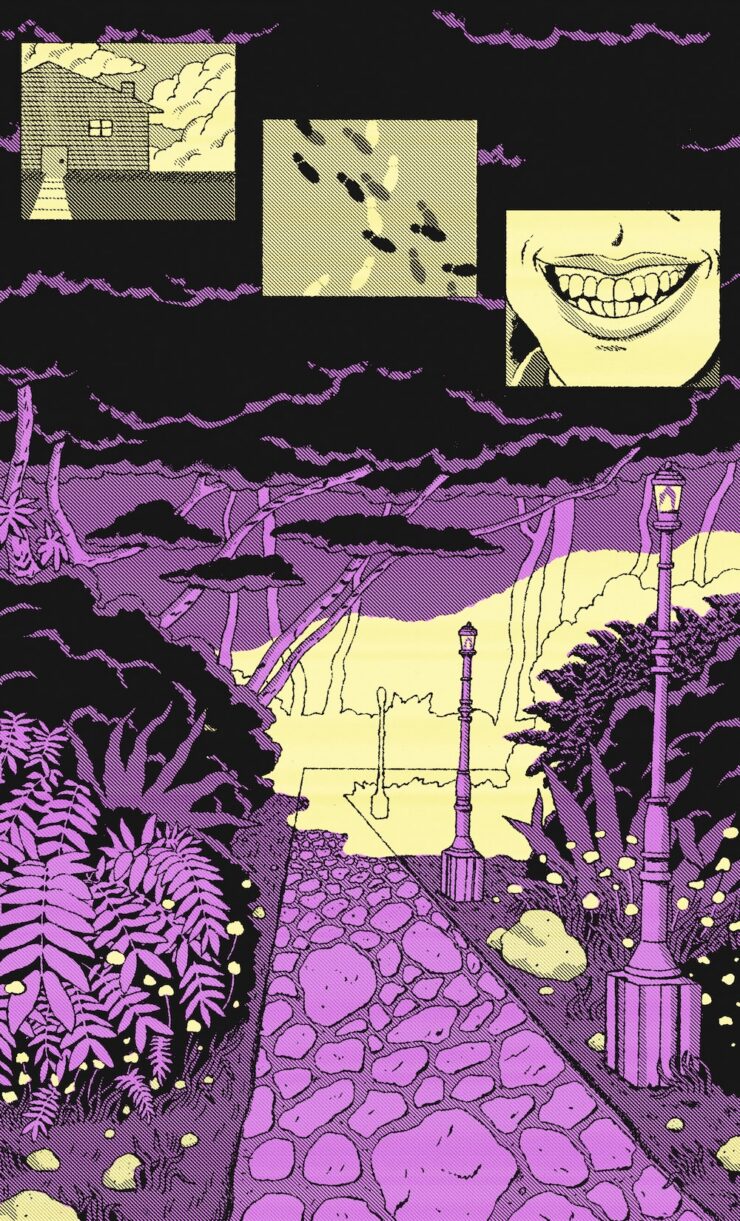
The strangeness began almost at once. The narrow track quickly became more recognisable, taking on the characteristics of a small footpath that had wound around the birch trees behind my childhood home. It was clearly just a coincidence, but in the shaky light and with my heart still working overtime, it looked horribly familiar, too much like my sentimental memory of it to be anything other than real.
Initially, I did what I’d been trained to do, and just kept on acting, disregarding any similarities to my own personal experience; but when I came to the end of the trail, the weirdness became too great to ignore: there in front of me was the house I’d lived in with my parents during my teens and early twenties. Not a property that resembled ours, Ellen. I mean the exact fucking thing, down to the last brick, the last roof tile.
I didn’t know what to think by this stage and I looked around for the film crew, seeing none of the apparatus that should have been there—the cameras either very well-hidden or having fallen through reality’s cracks, like so much else. When I realised this, I admit my commitment to the scene evaporated fast. I was standing on a soundstage looking at the damn house I had grown up in, for Christ’s sake! Suddenly, not a single second of that alternative reality made sense. I mean, it wasn’t supposed to, I knew that implicitly, but this was no longer a scene written for a crappy television show, it was a scene that had been lifted straight out of what now seemed like my own unreliable past. I half expected to see my old dog, Jojo, come bounding down the path, confirming once and for all that the dial was out of control in my head.
Whatever it was, it was no longer part of a wider story involving actors and a second-rate TV show. I didn’t know what I was witnessing at that point, but I did know that I’d somehow sidestepped the fictional world of Turn Right.
I could have circled back, I suppose, retraced my steps through the mist until I saw the cameras again, but what self-respecting artist could remain indifferent to the ghost of their own childhood home? Even one that was slipping off the beam fast. If my mind was coming apart, Ellen, I had a hunch even then that whatever lay inside the house might at least shed a little light on the reasons why.
I walked down the garden path and arrived at the front door, suddenly feeling like a twelve-year-old girl again. It was already ajar, and I pushed it open and entered the house. All manner of sights and smells assailed me from my childhood: my father’s muddy boots in the hallway, smells of overcooked cabbage and stewed meat coming from the kitchen, the carpeted staircase—homely and faded over time—leading up to the bedroom where I’d dreamed of one day becoming an actress like Audrey Hepburn and Brigitte Bardot.
“That you, Rosie?”
Memory insists that my body’s response to hearing that voice was a lot like falling into a deep sleep. But memory can lie, Ellen, you and I both know this. It can play tricks on us without us even being aware. Only my mother had ever called me Rosie, and she’d been dead for nearly fourteen years. Yet that was her voice, greeting me from the parlour, where she was probably warming her hands around a steaming mug of tea. I had no idea how this could be so, but I was in no doubt. A mother’s voice is the first sound a child responds to. And that had undeniably been my own mother, calling out to me, sending me spiralling back through time…
I walked down the dusty hallway and took the second door on the left into the small parlour. I was correct. My mother was sitting in her rocking chair, waiting for her tea to cool down, smiling at me as I made my way inside.
“You look tired, Rosie. Did Jojo wear you out?”
She didn’t look any different from how I remembered her from when I was a child. Hair in a bun, eyes bright and observant, rocking gently in her ratty old chair. Only, as I looked a little closer, the skin around her cheeks and mouth seemed a little off-colour—like she’d powdered her face with ash—and it was stretched taut in places. Like a mask pulled over the real thing. A mother-fitting membrane layered over her actual face. It was the most disconcerting thing I’d ever seen, and once I’d noticed it, Ellen, it was impossible notto see it. Sitting in the rocking chair was a rough sketch of my mother, a terrifying variation of her that cut into me like the sharp edge of a knife.
The rogue mother smiled, no doubt having seen me recoil.
“They never get it quite right, do they? There’s always something that gives the game away. What was it this time?”
I stared at her in horror. Seeing my mother was one thing, but seeing this thing replicating her—or trying to—was enough to make me stagger. I reached out and held on to the Welsh dresser for support.
“I can’t breathe,” I muttered. “I think I’m going to be sick…”
“That’s what happens when you turn right for terror, Rosie. You realise what it’s really like to be afraid.”
When I looked at the figure, I no longer saw the illusion; I saw what was behind the illusion, this strange glove-puppet mother, rocking away in her chair with her mug of tea, pointing out to me the defining principles of fear.
By this stage, I think I was starting to realise I was having an emotional breakdown of some sort. Not that this changed the circumstances any. I stood—just—in the parlour, gazing at the thing my broken mind had constructed from the ruins of my hollow life and that worthless show.
“I can’t look at you,” I said. “You’re not even real.”
“When has that ever mattered?” the Unmother said. “Life is just one long story, Rosie. You should always remember that…”
Her face changed then, as if to highlight exactly what she meant. This was a story, that’s all. Just the crazy, dreamed-up scraps of some sleazy writer’s journey into hell. It wasn’t just this life, I realised. It was all life. Every human experience adding to the narrative, until the path of history was forged, not in the reality we endured, but in the one we chose to create.
You look puzzled, Ellen. I don’t blame you, dearie. It is one seriously messed-up confection. But you have to trust me. I’m telling you what I saw, what I really felt, during that impossible interlude in my parents’ rickety old house.
Remember I was telling you about the Unmother’s face changing? Crazy as it sounds now, it seemed almost rational at the time, a logical progression of the deception my mind was revelling in. It was like watching my old art teacher mixing her paints, light becoming dark, then gaining definition as a completely new shade. That’s what this was. My mother’s jaundiced mask shifting and dissolving until it eventually assumed the appearance of my father.
“I left because I was a coward, Rose,” he said, his sad face making me want to cry. “Your mother’s right, you see. It always comes back to the same thing. Fear…”
I hadn’t seen that rugged face for so long, not since he’d left both my mother and me to fend for ourselves in 1957. Mother told me he’d run off with a trollop from Manchester, someone he knew through work. But perhaps it hadn’t been that. Perhaps he was just afraid: of life itself, of the story he was living, whose ending he had no desire to see play out.
“Daddy…” I found myself whispering.
He smiled—or the simulacrum did, the fake father—and then the face began to waver again, the features ambiguous, becoming indistinct, gyrating rapidly until what had once been a face was now just an eddying whirlpool of skin.
I was mesmerised, unable to articulate the repugnance and dread that consumed me. I stared at what had once been my father’s face and saw the features collapsing in on themselves as the Unmother shuffled through its pack of human profiles, finally settling on a new design and showing me the face of Tony Gatlin, looking as liquored up as ever.
“This is a terrible place,” Gatlin said, his words barely coherent. “Get the hell out while you still can!”
Oddly, I heard my real mother in my head saying: Drunk words are sober thoughts, having heard her utter them repeatedly to my real father towards the end of their troubled relationship.
The pack shuffled again, features collapsing, the face spinning fast. It reeled through a whole horde of them this time, half a dozen members of the Turn Right cast, including poor Stephen Meyer and Daniel, the young actor who had vanished on set, leaving behind only the fag end of a crudely severed arm.
I thought it would finally settle on someone, as it had before, but the illusions just kept on coming, the humanity getting lost in the blur of motion as one face was layered atop another, rendering the final portrait impossible to identify. I thought I saw Walter at one point, shifting darkly among the spiralling flesh, but it was all happening too quickly to be sure. In truth, it could have been anyone, or nothing—just another smudged image that instantly became something else. My eyes were sore from watching it, my head seeming to pound in sympathetic rhythm to the frenetic pace of the changes. The fragments of people I thought I knew continued to disintegrate before my eyes, barely even formed half the time, the layers of skin warping and splitting until all I could see was the final translation of what must have been the Unmother’s true face: a black, meaningless void, reflecting back at me just the sweeping emptiness of space…
I have to tell you, Ellen, I was about ready at this point to keel over and pass out; I could feel the first wave of light-headedness flickering behind my eyes. Whatever I was seeing, it made little sense then, and even less now. But I confess it in good faith, only because you fell under the show’s spell and became part of its story. You deserve to know what happened at the end. That’s all this is really, Ellen: a last tale at the end of the journey. It’s only right someone like you should hear it all from a reliable source.
After all that, you’d think there’d be nothing else to tell, dearie, but that’s not quite the case. Good stories rumble on, don’t they? The very best ones do, and this one comes close to that, I suppose, flirts with the very edges of it, at least…
There was one more face the Unmother wanted to show me. And before I turned and fled, while I was still trying to ride out the unsteadiness and the buzzing sound in my head, I looked at the Unmother and saw the churning black mass submit to its state of flux and settle into one final face: my own.
I stared at myself, a fresh tide of horror and disbelief washing over me. I looked like a diabolical monster: frog eyes bulging, wine stain a smear of black tar, the whole arrangement a miserable parody of what a human face should be like.
The other Rose smiled at me and said, “Nothing in life is to be feared, child, only understood. And remember: a truth will not cease to be true if you silence the speaker.”
That was the point at which I broke, Ellen. I turned and ran, screaming for Vic Smedley, for Walter, for any bugger who could assure me that the Unmother was nothing more than a throbbing clot in my rapidly deteriorating brain.
I don’t remember much more, except to say that every word of what I’ve just said is honest testimony. Because I can still see it, Ellen. That damn thing in the rocking chair. The Unmother. Warming her hands around a mug of tea, the composition of her unstable face turning black.
We sat in silence, staring out the bay window at the rain. Business in the care home carried on around us as usual. The elderly residents were chatting away to each other in the lounge while the care workers distributed medication, tucked blankets around chilled legs, checked blood pressure with portable machines.
I turned and studied Rose’s profile, the actress who had enriched my childhood as Bird Dog now looking as delicate as a moth. I tried to process what she’d just told me but didn’t know where to start. If one of the carers hooked me up to the blood pressure machine, I had no doubt my old heart would still be accelerating through the gears. I could feel the damn thing pounding away inside my chest. I always thought that was an old wives’ tale, but I guess sometimes those old dears knew what they were blathering about. Rose’s tale had been quite a thrill ride; my straining ticker could testify to that.
I suddenly felt a profound sorrow for the woman watching the rain in the adjacent armchair. What had she said as her remarkable tale had unfolded? Memory can lie, Ellen, you and I both know that. It can play tricks on us without us even being aware…
“Awfully quiet over there, girlie. Cat got your tongue?”
I smiled, not knowing if there was a right thing to say at this point. I ended up muttering, “So much to take in,” feeling like a simpleton with half a brain.
“It’s not an easy story to tell. It still haunts me, though the timeline’s not quite as clear as it once was.”
“Did you tell anyone on set what had happened in the house?”
Rose seemed to consider that for a moment. “What the deuce would I have said? I didn’t understand any of it, not then, not now.”
I smiled and nodded, not wanting to distress Rose after such a lengthy monologue. Thing was, I think I did understand it, the underlying gist, at least. It was about fear; all the things Rose was afraid of. The things that had terrified her when she had been making the show—like Walter humiliating her, the various problems that had arisen during the shoot, the apparent banality of Turn Right itself, and her limited role within it—along with the things that frightened her now: getting old, being lonely, the act of forgetting.
I thought back to Bird Dog’s singular moment in the spotlight and couldn’t help wondering about Rose’s revelation that she thought she’d first heard the line from her own mouth in her childhood home.
“I always wanted to ask you about the very end of the series,” I said. “The line of dialogue you delivered seemed to enter the public consciousness, as though that specific message needed to be heard at that particular time. From your story, there seems to be something almost, I don’t know… uncanny about it.”
Rose adjusted herself in her seat and smiled. “If that’s how it seems, dearie, then that must have been exactly what it was.” She paused, before adding, “You know, the truth is I don’t even remember recording that scene at all or saying that odd little line. Much later, I asked some of the crew about it, a few of the other actors, too. They didn’t have any recollection of it, either. But when the final show was broadcast, there it was. Bird Dog’s one and only line! Spoken directly into the camera as though the nation was waiting with bated breath to receive its truth.”
I made an effort to digest what she was disclosing, hardly surprised that her most pivotal moment in the entire series was now just a blank spot in her shrinking brain…a meaningless black void, reflecting the sweeping emptiness of space…
“That line,” I said, thinking fondly of how it had been assimilated by the nation, dominating the cultural agenda for so long, “it really blew people away. You remember that?”
She closed her eyes and nodded, a faint smile pinching the edges of her wine-stained cheek.
“A truth will not cease to be true if you silence the speaker,” she said softly, pointing out to the meadow in tender recognition of her strange television alter ego, Bird Dog.
Wisdom that could ring down through the ages, I thought. Bird Dog had found a way to make her voice heard when those around her had demanded she be mute. There was something magical in that; something extraordinary…
It occurred to me as I sat there that the universe had a thin skin, and I thought of my husband and Rose and even myself, at the mercy of the passage of time. The secrets embedded in our own history had a way of getting out, and every time they were passed on, those old ghosts found a way to survive.
The past haunting the present, speaking up and demanding to be heard.
“Turn Right for Terror” copyright © 2026 by James Cooper
Art copyright © 2026 by Claire Merchlinsky
Buy the Book
Turn Right for Terror
